Showing posts with label Gearhead. Show all posts

Monday, May 27, 2013

Finally figured it out...

I have recently switched back to using an Astatic mic for harp blowing, and have been thinking about how to park the mic up at the front of the stage with me when I'm not using it.

This is simple to do with a wand mic, like the Shure 545 that I have been using for a while now.  Just put another mic stand next to the vocal mic stand and put the wand mic in a standard mic clip.  However, the Astatic won't fit into a standard mic clip.

Here's what I figured out for the Astatic after a brief trip to American Music in Seattle's Freemont neighborhood:

First, I bought a bracket designed for attaching mics or small (very small) speakers to a mic stand.


Then I attached one of the spring-loaded type of mic clips.


Then I popped the Astatic (including the volume control and 1/4" plug adapter) into the mic clip.


This looks like it will work fine.  The clip has a firm grip on the mic, and the extra mic stand is eliminated.  I'll try it out on stage this Thursday at the Preachers gig in Portland.

You can check out the Boneyard Preachers here.  See you at the nightclub!

Sunday, March 24, 2013

Bassman Amp Update

In our last episode regarding my new reissue Bassman, I mentioned that I was going to recone a quartet of CTS alnico speakers and try them out in the amp.

So, had the speakers reconed by Seattle's Around the Sound speaker reconing service.  Carsell, the owner, thinks that the speakers are actually Oxfords, not CTS, even though they look just like the CTS speakers.  However, the CTS speakers usually have a manufacturer's code stamped on the frame, and these speakers do not.  There are square blue Fender labels on the magnets, and a couple of these labels show a Fender part number of 064121 which indicates an Oxford speaker.  These speakers have 1.5" voice coils, are rated at 25 watts power handling, and were probably installed by Fender in their Super Reverb or Vibrolux Reverb amps in the early '70s.

After I picked up the reconed speakers, I installed them in the Bassman (a pain in the arse, by the way - the amp has to be removed to get the upper speakers out) and tried them out at a gig that night.  I didn't like them at all - they had a compressed, middy tone that I found uninteresting, so it's back to the reissue Jensen P10Rs for now.


Reconed Oxford speakers


Reissue Jensen speakers

The Jensens are too bright and crunchy to my ears, but I'll have to live with them for a while.  I believe that I will end up installing new Weber P10R clones in this amp.  More expensive, but I'm pretty confident that they will sound great. So...


Let's play some blues!

You can check out the Boneyard Preachers here.  See you at the nightclub!

Sunday, February 17, 2013

Reissue Bassman LTD project

I recently traded my very nice Fender Vibrolux Reverb for a very nice (practically new) Fender Bassman LTD amp.  The Vibrolux is a great guitar amp, but I was never really happy with how it sounded for harp, no matter what mic I used with it.


There's a new Bassman in town.

The Bassman LTD is Fender's reissue of the coveted 1959 Bassman, which was a failure as a bass amp but a very successful guitar amp.  It's a printed circuit board amp unlike the hand wired original, and is rated at 45-watts of output into four 10" reissue Jensen alnico speakers.  The channels can be jumped on this amp, which is a good thing!

However, I have never been crazy about the reissue Jensen speakers, and they sound kind of harsh to my ears in this amp.  Stoop Down gave me a box of ruined CTS (Chicago Telephone Supply) alnico speakers recently, so I am going to have them reconed and try them out in the Bassman.  These are the same speakers that are found in many of the mid to late '60s Fender Super Reverbs.


These.Speakers.Are.Dead!

I can have all four of these speakers reconed for about the price of a single new Weber Jensen clone, so it is worth a shot.  Hopefully, I can get these into the Bassman before our gig next month at Leatherheads Pub in Stanwood. 

See you at the nightclub!

Check out the Boneyard Preachers here: http://www.reverbnation.com/boneyardpreachers

Sunday, February 03, 2013

The Preachers' Gear

I have had a couple of people ask me what equipment the Preachers use, so here's brief overview for you.  You know, in case you are wondering too...


I use an early '70s Fender Vibrolux Reverb to blow harp through.  Mics are either a Shure SD545 or my new recently rebuilt Astatic with a controlled reluctance element (thanks again, Lauri!). I use Golden Melody harps. 


Guitarist Tim Sherman plays a Custom Shop Fender Stratocaster or a Gibson ES-345 guitar through a '70s-something Fender Super Reverb amp.  He doesn't use any pedals.


Guitarist Steve Yonck plays a Fender Stratocaster of a Gibson Les Paul through a Peavey Delta Blues amp.  This is the model with the single 15" speaker.  He doesn't use any pedals either.


Bassist Patty Mey plays a Pedulla bass guitar, through a Genz-Benz Shuttle amp and an Eden cabinet with two 10" speakers.  Bass players have really benefited from technology - this setup works just fine in every size room that we play.  Remember the refrigerator-size cabinets that had to be hauled to gigs back in the day?


Drummer Conrad Ormsby plays a Boom Theory trap set, made here in the Northwest.  Check out that long kick drum - it sounds like a cannon going off!  Conrad also uses a very small floor tom.

That's it kids, see you at the nightclub!

Check out the Boneyard Preachers here: http://www.reverbnation.com/boneyardpreachers

Sunday, October 10, 2010

Seattle Amp Porn - Pt. 1

Our good friend and excellent guitarist/bassist/singer Greg Roberts recently invited Jet City Blues to his Seattle home to check out his collection of vintage amps and guitars.  Here are some photos from that visit for you gearheads out there.  Enjoy!


Greg Roberts with his 1956 Alden guitar.  Similar to the Stratotone guitars, these axes were manufactured by the Harmony company and were available through Montgomery Ward back in the day.

A 1938 Gibson EH-185 amp and matching 11-string lap steel guitar.
The amp and cabinet is in beautiful condition.  The amp has both bass and treble controls, an unusual feature at the time.


The amp is actually a head that can be removed from the cabinet.  Here you can see the original 12" speaker, which still sounds great!


A 1950 Fender Pro Amp with a Jensen P-15N speaker.  This "TV" model cabinet would have had a tweed covering originally, but someone thoughtfully covered it with fake snakeskin sometime in the past.


It's not unusual to find old Fender tweed amps recovered or painted black (a friend of mine has a old Bassman that someone painted red!).  It's a mystery why someone cut the two holes in the bottom back panel here.


A 1963 Fender Reverb tank, prized by many players as the best sounding outboard reverb units.


This cabinet is also the wrong color, with the exception of the back panel.  Fender made the brown tolex covered amps for only three years.


Guild amp, circa 1961-62.  Similar to the Fender Pro it also has a single 15" (Utah) speaker.


Rear view of the Guild amp.  Note the wood reverb/tremolo footswitch.


A 1969 Fender Vibrolux Reverb amp.  This was manufactured shortly after Fender was bought by CBS, but still has the pre-CBS circuitry.  This is the same type of amp that Roy Buchanan played.


Rear view of the Fender Vibrolux Reverb.  Two 10" speakers and reverb/vibrato footswitch.


A Magnatone Model 213 Troubadour amp with reverb, vibrato, and one 12" Utah speaker.


These Magnatone amps have a beautiful true pitch-bending vibrato. 


An early '50s Leilani amp with a 6" speaker and Mother of Toilet Seat covering.  All distortion, all the time!


Last but not least - a very nice 1967 Gibson ES-330 guitar with single-coil pickups.

I am aware of a couple of other amp/guitar collections here in the Seattle area.  Keep an eye out for more amp porn to follow soon!

Saturday, November 29, 2008

Seydel Harmonicas - the new Sheriff in town?

I have been playing Hohner Harmonicas since 1972. I started out with the Marine Band, moved on to the Special 20, and have been using the Golden Melody model for years now. In my opinion, one thing has always been consistent with the Hohner harps over the years - poor quality control.

Buying harmonicas at the music store is problematic, because, unlike other instruments, you can't play the darn things before you buy them! Every store has the totally inadequate countertop bellows device that can be used to blow air through the harp, but all this tells you is if the reeds are working, not how hard (or easy) the thing is to play. I can't tell you how many times I've found a brand new harp impossible to play, and, because I've had it in my mouth, the store won't take it back.


Seydel Silver harp with plastic comb.

What to do? Well, you can buy a Hohner from the music store then send it out to a customizer, who can dramatically improve the playability of the instrument for a typical fee of $100-$150 (for a 10-hole diatonic harp). Of course, the pros keep these guys pretty busy, so the waiting times can be long. Plus, once you add the customizing fee to the current $30-$40 price of off the shelf Hohners, you are looking at a pretty large hunk of change for a complete set of instruments.

So, I was intrigued a few weeks ago when Seattle blues harp maestro Bubba McCoy called to tell me that he had been set up as an authorized distributor of the Seydel line of harmonicas. I had been hearing about the Seydel harps for a while, so I ordered a Seydel Silver harp in the key of C to replace the terrible Hohner Golden Melody I had purchased recently.

Wow - what a difference! The Seydel sounds great, plays beautifully, and feels good in the hand and mouth. On of the nice things about Seydel is that you can order the instruments (including chromatics) in all sorts of tunings, including the hard to find "low" tunings, which means I can finally buy the low F harp that I've been wanting. Of course, the Seydels should be an improvement over the Hohner - at a list price of $90 a pop for the Silver instrument (with a plastic comb), they are not cheap. However, if the quality of the next Seydels I purchase is the same as this first harp I bought, I will start retiring the Hohners.

Interested? First, check out the Seydel web site for more information on the product line, then give Bubba McCoy a call at 206-799-7675 for pricing and availability. Tell him the Playboy sent ya!

Sunday, September 21, 2008

A few words about basses…

By Mark Dalton

Mike asked me to write a piece about my basses, and specifically about ace instrument maker and former Seattleite Steve Davis and the “Tall Cool One” basses he makes. This seemed like a good idea for something to write about – it had never occurred to me, although people come up to me at gigs fairly often (usually other bass players) and ask about my basses (whichever one of the four I happen to be playing at the time), and I’m always happy to talk about them.

I owned only one bass for the first 20 years of my professional career, and I’ve still got it, but it is stowed away somewhere nice and safe and I take it out to a gig about once a year. It’s a 1959 Fender Precision Bass that I got in a swap deal with the original owner in 1965. It’s a sweet ax, with great tone and a nice neck. I’ve had the same set of strings on it for over 20 years too; big heavy flatwounds, of course, and they are completely dead – no twang left whatsoever. Just a good solid deep-throated thump. I remember reading an interview with Donald “Duck” Dunn (of Booker T, Otis Redding and Blues Brothers fame), and he was talking about how he broke the G string on his Precision (part of set he’d had on there for 17 years at the time, as I recall), and he just burst into tears at the thought of having to break in a new string, or worse, a new set of strings!

People started coming up to me at gigs after awhile and looking at this old bass with such lust in their eyes (old Precisions are rapidly increasing in value) that it got kind of scary – so I got another one – a Mexican Precision, really well made (I tried out a bunch of them), with a nice straight neck and thin frets that was really close to my 59, for about $300 bucks in around 1992. I set it up the same as my other one, low action, fat flats, and it sounded almost as good. And I didn’t have to worry so much losing my old one and the history we shared.

A couple years after that, I started getting interested in five string basses – both because they had an extra low string, and because I heard a few that had advanced electronics – big fat active pickups that captured thick overtones – I was listening to a funk band playing right before us – Guitar Slim at that time - at the Bite of Seattle, and the sound of this guys five-string was amazing – the sound was so fat that individual notes sounded almost like chords. So I found one I liked and played it exclusively for several years (once I figured out how to integrate that additional string). Five strings also have a slightly longer neck than regular electric basses – gives the strings a little tighter feel, and, for a guy with big hands, the longer scale felt just right. I still have it, and I still play it every now and then.

Here’s where Steve Davis came in. Steve used to live up around North Bend, and he used to come out and hear Guitar Slim a lot. He and Pat Chase, our guitar player, got to be friends, and he made some cabinets for Pat’s house in Snoqualmie that were really nice. Steve is a wood worker and furniture maker by trade and he does very fine work. So it came as no surprise to Pat when Steve talked about making a guitar some day. The surprise came when Steve actually did make Pat a guitar – a gorgeous instrument in Pat’s favored Stratocaster design, but a custom-shop instrument all the way, including “Guitar Slim” inlaid in mother-of-pearl on the fretboard.

So it was somewhere around 1999, we were playing the Pike Market Street Fair when Steve came over on a break, and said “Marcus, I’ve been thinking… how would you like me to try my hand at building you a bass?” Well, what do you say to that? “HELL YES!” is what you say. Especially after he explained the deal to me – I help him with the design, as this was the first bass he’d attempted, and I buy the pickups and hardware, and he kicks in the wood and labor. At this point, I’m looking up into the heavens with my head swimming - as middleweight champ Rocky Graziano used to say, “somebody up there likes me!”

So Steve came over to my house and swarmed over the basses I had, with rulers and micrometers… Whaddya like about this one? How about this one? What body style do you like? What scale do you like? (I opted for the long scale, which at the time was rare for a four-string bass.) What color do you want? (As it happens, I had a copy of a great coffee table book called “Blue Guitar” that had a custom guitar with exactly the blue finish I wanted. Steve contacted the guy that made the guitar in the book, and got that exact finish for the bass – this is the lengths that he will go to get things right!)

The Tall Cool One

Over the next couple of years I would get tantalizing glimpses of this work in progress via E-mailed photos (Steve, by this point, had moved to New Mexico, where he was making custom furniture for the likes of Robert Redford.) And then, one lovely spring day, the Blue Bass arrived. I picked it up, plugged it in, and it was like I’d been playing it for years immediately – because it had everything I liked built in from the beginning! Big, active Bartolini pickups (I’m sorry, but once you get used to these, going back to a Fender Precision is difficult, if not impossible in the long run), neck-through-the-body construction for amazing sustain and a solid feel, and a beautiful finish. It also had a nameplate on it that said “Tall Cool One” – a national hit song for the Wailers, Mike Lynch’s nickname for me since the early-80’s Bluestars days, and now the resonant name of the Davis bass design.

I love my Blue Bass, and more recently, Steve finished a sister instrument for me – “The Red Bass.” She is really a beauty – refined, sleek, cut away in all the right places, a pleasure to hold onto and play! The Red Bass has an EMG pickup (my choice again), and getting the sound just right on her is still a work in progress (I had heard great things about the EMG, but it is… different). The bottom line is that this beautiful bass plays just great.


Red bass - in the shop


Avert your eyes!!

I’ve had tremendous good fortune in the people I’ve met and became friends with throughout my musical adventures, and I’m here to tell you, the people around you, supporting you, educating you, giving you the gift of their friendship – this makes all the difference in the world of making music. Steve Davis is one fine instrument maker, and one hell of a good man!

Originally from Nebraska, Mark Dalton moved to Seattle in the early '70s. He is an accomplished bassist and stalwart bluesman. He currently plays with Chris Stevens' Surf Monkeys. Photo by Ronda Lee.


Monday, October 31, 2005


Amplified harp tone tip – channel jumping.

By the Tone Chaperone

I blow harp through a Victoria Bassman clone that I bought from Stoop Down about a year ago. A damn fine amp, it’s a clone of the classic 1959 Fender Bassman amp that was a flop as a bass amp but became very popular with guitarists. The original Fenders are collectors items now – originally costing about $340, these amps in very good condition are selling for over $4,000 these days.

The Bassman is also a great harp amp. In fact, it’s kind of unusual to see pro blues harp players not using a Fender Bassman or a reasonable facsimile. With 45 watts of power and four ten-inch speakers, this amp can deliver the big, fat harp tone that has been heard on gazillions of blues recordings.

Like most gearheads, I’m always fooling around with my amp, mics, cords, etc. in the never-ending quest to improve my tone. I recently discovered that, by jumping the two channels in my Victoria, I can sort of supercharge my sound. I guess this is a trick that guitar players have known about for ages. Here’s how it’s done:

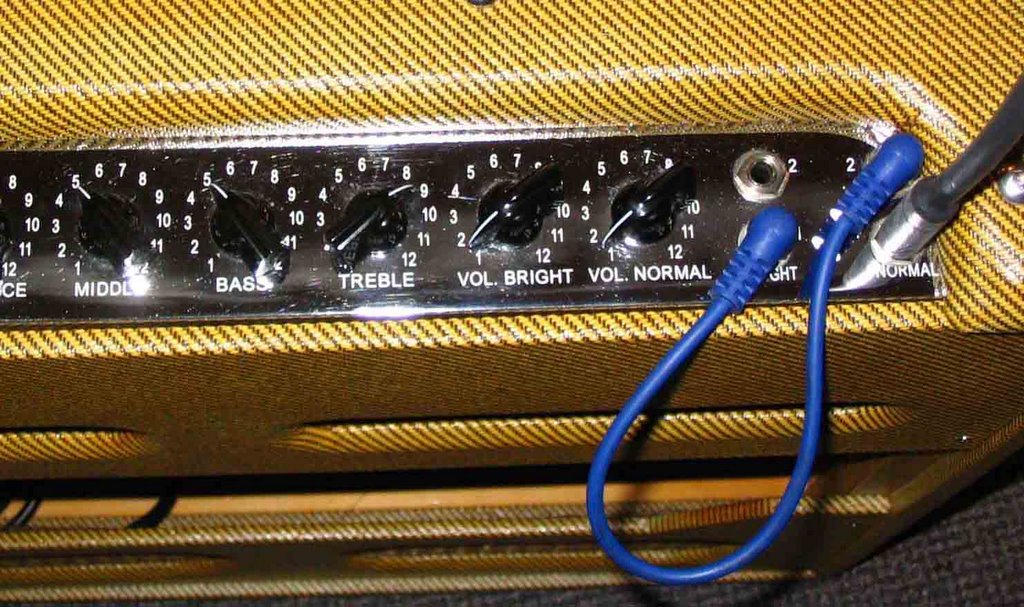
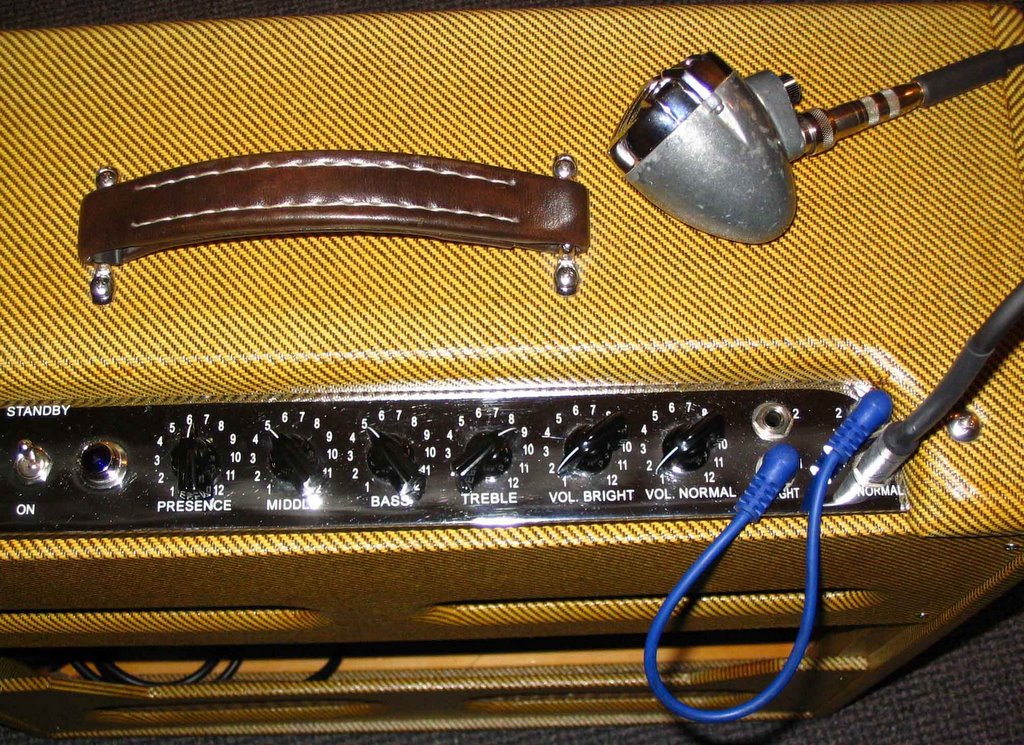
1. Plug the mic cord into the No. 1 jack of the Normal channel.

2. Plug one end of a patch cord into the No. 2 jack of the Normal channel.

3. Plug the other end of the patch cord into the No. 1 jack of the Bright channel.

Now the Volume controls on both channels are active and affect the volume and tone of the amp. This seems to add more punch and presence to an already great sounding amp. The channels can also be jumped the other way - that is, from the Bright to the Normal channel. I really dig this sound and patch the channels together on my amp all the time now.


Normal to Bright channel jump.

However, channel jumping might not work too well for a rookie harp player having the usual problems with feedback. Getting the two volume controls balanced will be a lot easier for an experienced player with good mic technique.

Next up: I’m probably going to replace the Chinese and Russian tubes in the Victoria with New Old Stock (NOS) tubes. I’ll keep you posted.

Thanks and a tip of the hat to Nick Carnavalli for hipping me to the channel jumping technique. For an excellent reference on Fender amplifiers, check out “Fender Amps – The First Fifty Years” by John Teagle and John Sprung. Good stuff!