Monday, October 30, 2006

The return of Lonesome Jerome.

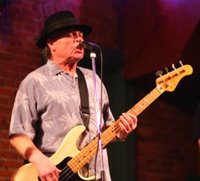
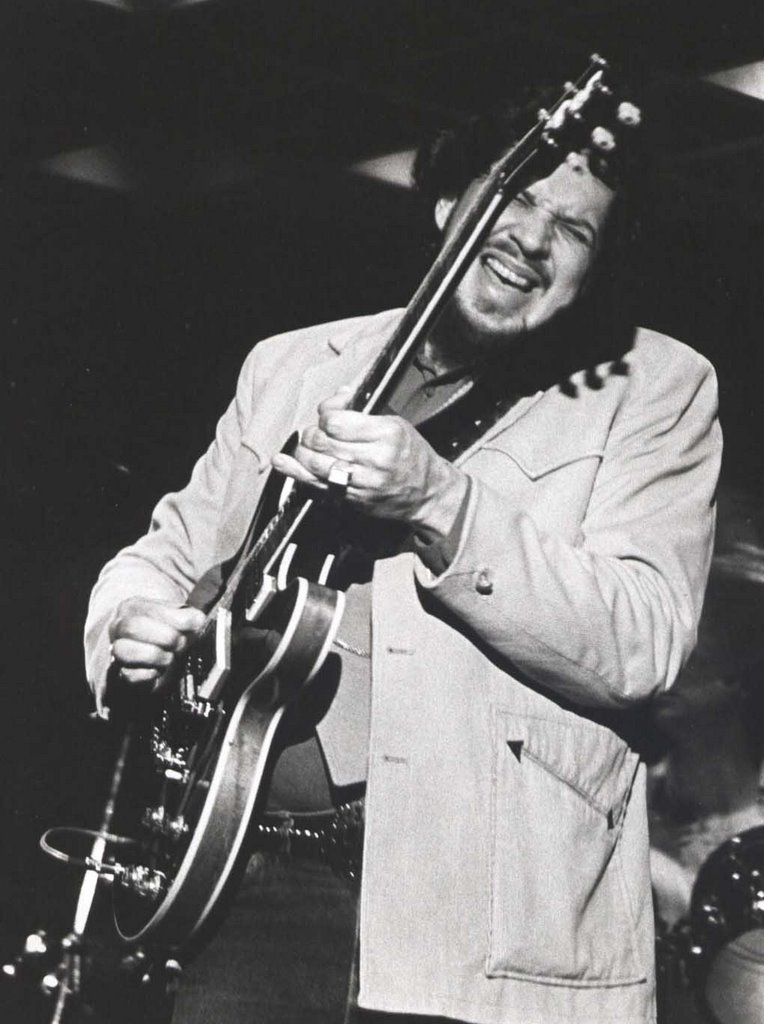
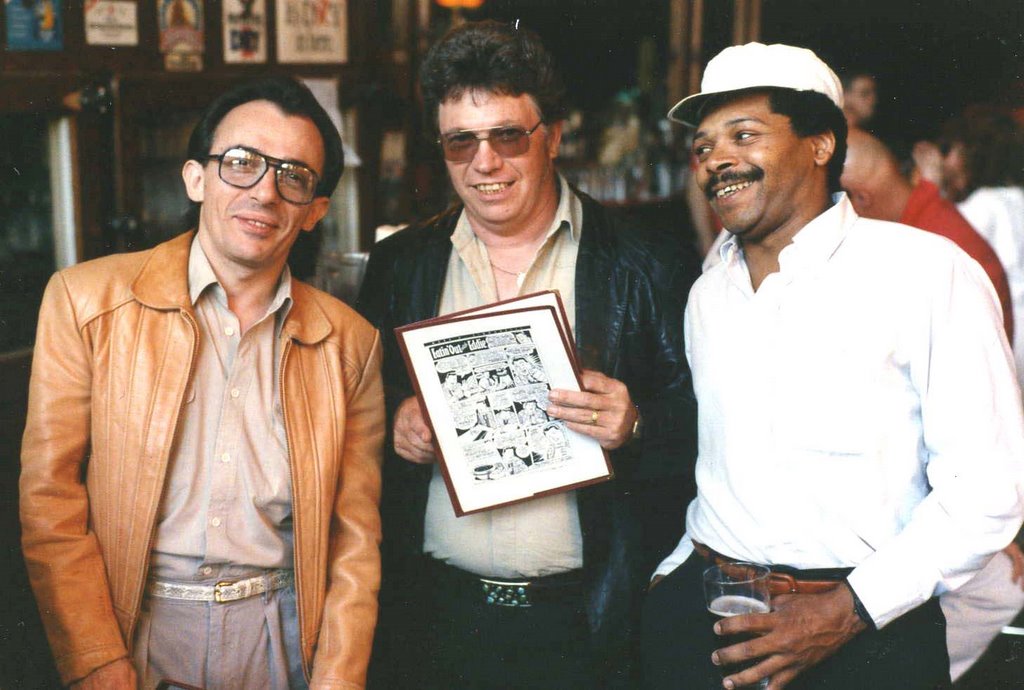
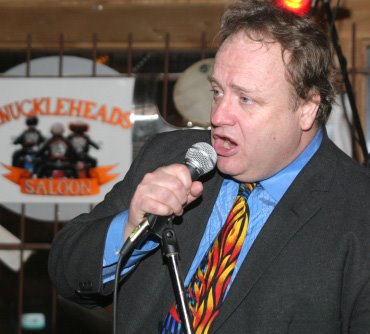
I was at the Highway 99 Blues Club last Friday checking out the West Coast R & B Summit show when I ran into Mark "Lonesome Jerome" Dufresne (left). He confirmed that he's no longer working as the lead vocalist for Roomful Of Blues, and is now living back in the Jet City with his wife Laura.

Welcome back Mark! Come on down to the Blue Monday jam one of these days - we'd love to see and hear you singing and blowing harp on the scene again.

Note: Mark's photo was created by Henry Benson. From the Alligator Records webpage.

Sunday, October 22, 2006

Memo to my fellow Seattle Blues Nazis.

While I was perusing the October 2006 edition of the Washington Blues Society's Bluesletter today, I read Roy Brown's monthly "Sound Off" column. In this column, Roy reprints a letter from Seattle singer Mary McPage, who fronts the Mary McPage Band.

In her letter, Ms. McPage, discribes the 1998 Seattle Blues Nazis as a "...negative, hateful, splinter group..." of the WBS. Then she describes the current Blues Nazis organization as "Blues Police" who are arrogant, "ignorant idiots." Apparently, she picked up the Blues Police moniker from a recent Blues-To-Don'ts blog article.

Oh boy - OK, first of all, I want to reassure all of you that we have not changed the name of the organization from the Blues Nazis to the Blues Police. As we have all endlessly discussed, Blues Nazis is the perfect name, since it seems to irritate the most number of people possible. Also, the logo artwork for my sometime band, Kid Porno & the Blues Nazis, is bought and paid for, so it's too late to change the name of the band.

Now here's the thing that really concerns me - remember our last meeting (sheesh, a couple of years ago now) when we all decided to keep a low profile? We all agreed that there wasn't any money in trying to advance the cause with people that still think that "Messin' With The Kid" was written by Jake and Elwood Blues, or that "Somebody Loan Me A Dime" was written by Boz Skaggs (or the Allman Brothers). So, what the hell - which one of you guys pushed Ms. McPage's button? Frankly, I'm confused - there hasn't been much in the way of dissenting opinion in the Bluesletter for years, and I doubt that Mary's band gets heckled by any of our minions, so why the whining on her part?

You know what? I think she's mad at Brother Chesnut. Now, I know (I know!) that sometimes our Art Director, Phil Chesnut, can't help from speaking his mind. Heck, Ms. McPage says in her letter that "...Just because one can write about the blues, take a picture of blues musicians or perhaps draw nice litle pictures, does not make a blues expert..." Goodness! Take one for the team, Phil!

Anyway, let's hope this latest incident will blow over and we can continue our Blues work behind the scenes. Keep up the good work, fellow Blues brothers and sisters! Check your decoder rings for our next meeting date.

Wednesday, October 18, 2006

Musings from Mr. Solid

By John Lee

I had planned on talking about a number of music DVD’s in this space. That will be one of the things, along with books and recordings, that I will save for the fall and winter Musings.

Recently, I’ve been putting together what I think is a top-notch show that has had my full attention for the last two months. Below is the press release. It appears on the KPLU and the Highway 99 Blues Club web sites. Everyone involved is hoping you can join us for what I think will be one hell of a party!

The West Coast Rhythm & Blues Summit


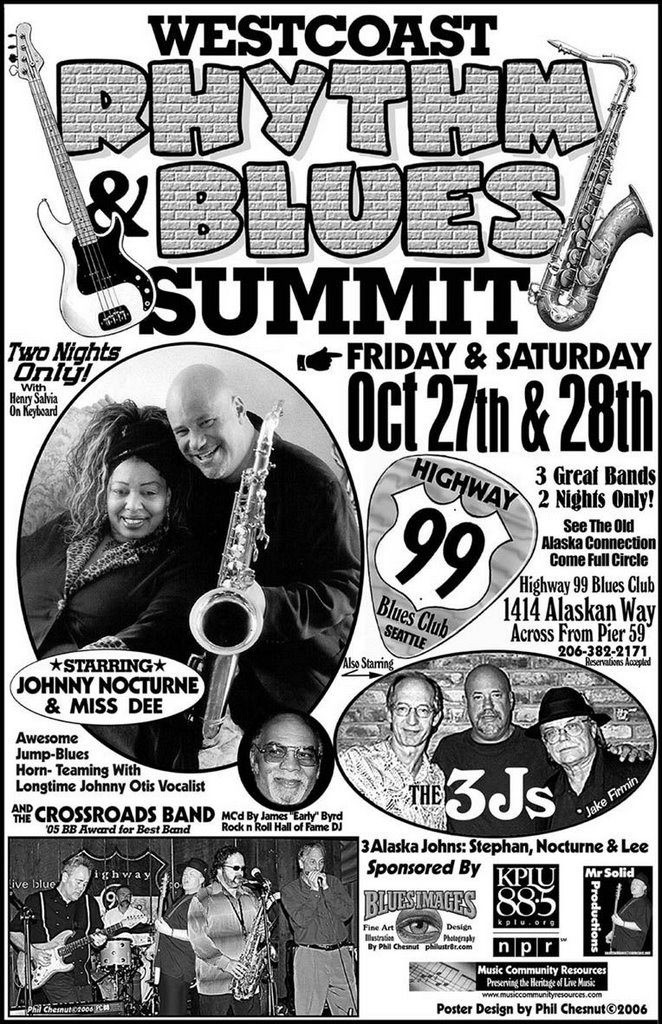
For two nights, October 27th and 28th, 2006, The Highway 99 Blues Club in Seattle will become the scene of what amounts to a classic Rhythm & Blues revue. It’s a triple bill, starring Johnny Nocturne (John Firmin), who the San Francisco Jazz Festival called “The Big Daddy of retro jump-blues tenor saxophone”. The show also stars Miss Dee, long time vocalist with the legendary Johnny Otis Show. Miss Dee is the vocalist on the Johnny Nocturne Band CD “Blues Volume”. This portion of the show will also highlight Nocturne keyboard man, Henry Salvia.

The R&B Summit also includes The Crossroads Band, the Washington Blues Society’s “Best Band” of 2005. Crossroads is a five piece group of seasoned veterans. The Tacoma Weekly said about the band’s new CD “In case you have never seen them play yet, this record makes you want to change this fact as fast as you can.”

Special guests are The Three J’s Alaska reunion band, consisting of John Firmin (aka Johnny Nocturne), John Stephan (John Stephan Band), and John Lee (The Crossroads Band). Describing the Three J’s self-titled CD, Misty Blue, a Canadian radio show host, said “ Alaska sure can rock the blues!” Henry Salvia who plays on the 3J’s CD, will join the band.

Master of Ceremonies for the show will be Rock and Roll Hall of Fame disc jockey, Jimmy “Early” Byrd. “Early” Byrd is the first African-American disc jockey elected to the Hall. The other DJ’s in the Hall of Fame are Alan Freed, Wolfman Jack, and Dick Clark.

Where: The Highway 99 Blues Club-1414 Alaskan Way , Seattle , WA (206-382-2171)
When: Friday October 27th and Saturday October 28th 2006. Showtime is 8:45 PM.
Cover: $15.00

Links:
http://www.johnnynocturne.com/
http://www.crossroadsblues.net/
http://cdbaby.com/cd/3js
http://www.johnstephanband.com/
http://www.earlybyrd.com/
http://www.highwayninetynine.com/

For additional information call Mr. Solid Productions at 206-517-7864.

When you see a musician on stage having fun, remember all the hours and hard work it took to get to that place. Also take into account the true nature of the beast. I think the late, great Hunter S. Thompson summed it up best: “The music business is a cruel and shallow money trench, a long plastic hallway where thieves and pimps run free, and good men die like dogs. There’s also a negative side.” Amen, Brother Thompson!

Last time in this space I made a serious omission: Ray Charles’ birthday. “Brother” Ray was born September 23, 1930. Ray passed away June 10, 2004.

Peace! Check you on the rebound.

October Blues Birthdays

Keb Mo - October 3, 1951
Albert Collins - October 1, 1932 (died 1993)
Stevie Ray Vaughn - October 3, 1954 (died 1990)
Lonnie Pitchford - October 8, 1955 (died 1998)
“Ivory” Joe Hunter - October 10, 1914 (died 1974)
“Jelly Roll “Morton - October 20, 1890 (died 1941)
Sonny Terry - October 24, 1911 (died 1986)

Electric bassist John "Mr. Solid" Lee was born in Alaska and has been active in the Seattle blues scene for about 30 years. He currently plays with the Crossroads Band. Photo by Mike Coyote.

Note: The poster that appears in this article was created by Phil Chesnut.

Tuesday, October 17, 2006

Down to the nightclub...

You know, the Great Northwest has a sort of embarassment of riches when it comes to blues harp players. Sheesh, Portland alone is the home of Paul deLay, Curtis Salgado, Bill Rhodes, Johnnie Ward, Mike Moothart, and LynnAnn Hyde.

We've got some good 'uns in Seattle too, including Steve Bailey, Kim Field, Mike Wylde, Brian Lee, Bubba McCoy, Jim King, Dave Prez, Paul Green, Jeff Herzog and John Deely (forgive me if I've forgotten anyone). Speaking of Dave Prez and Paul Green, I had a chance to see these blues harp maestros playing live recently - check this out:

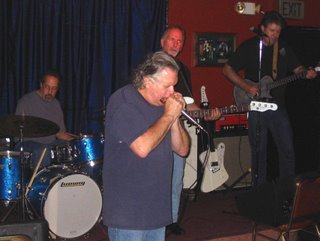
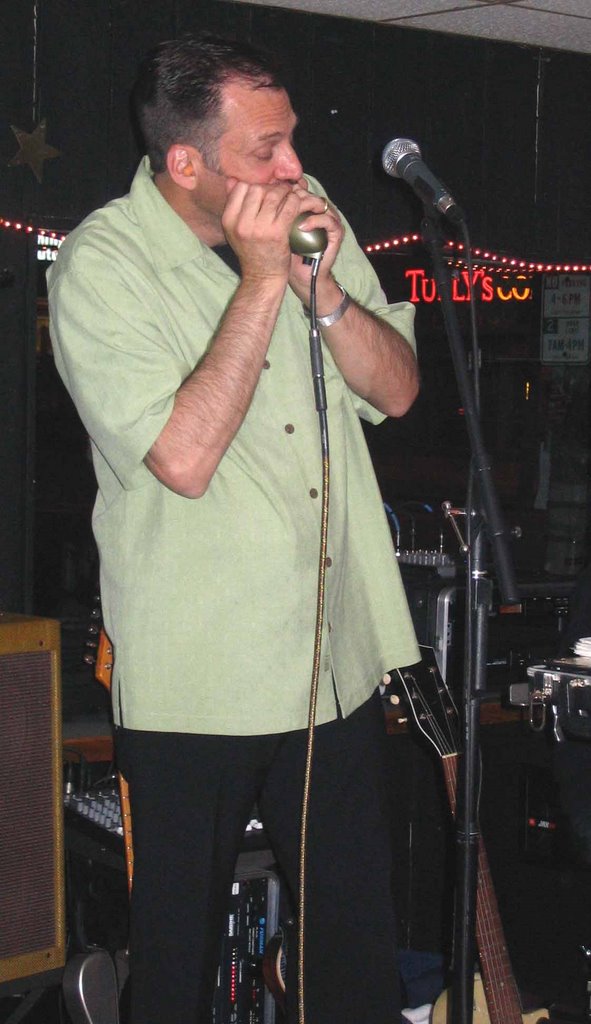
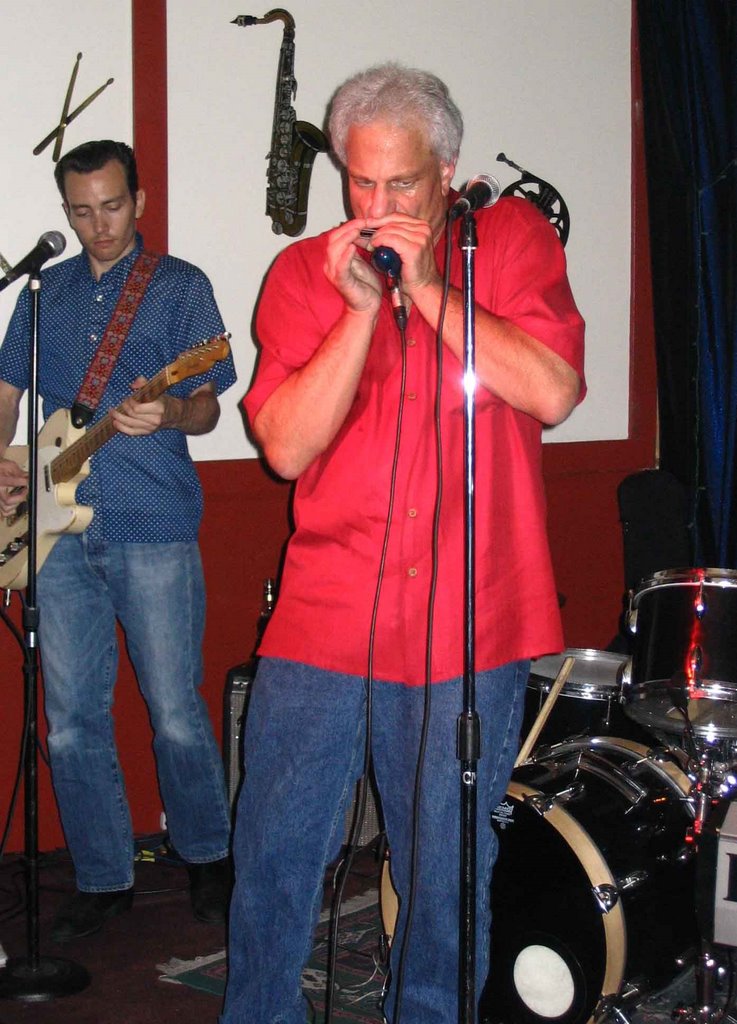
I caught up with Dave Prez (left, with guitarist Eric Daw) and the Combo Nation at the Salmon Bay Eagles Club. Besides Eric, the other members of the Combo Nation that night included drummer (and sometime vocalist) "Sweet" Billy Spaulding, and multi-instrumentalist/singer/songwriter Jeff Simmons on electric bass and keyboards.

Dave is one of my favorite harp players. He is very good at applying the tongue-blocking technique, which produces his big, fat tone. I guess you could say that Dave is sort of Seattle's Little Walter specialist - you ought to hear his version of Walter's "Fast Boogie." I'm here to tell you he smokes on that tune! However, he was a little hard to hear clearly this night except right in front of the bandstand, probably because he wasn't micing the small Gibson amp that he was blowing through.

The band was playing straight ahead blues tunes, with the always excellent Eric Daw doing most of the singing while I was there. Unfortunately, I had to leave just as Mr. Simmons was preparing to do a set from behind the keyboards - I hear the band had a ball until closing time.

I saw Paul Green & Straight Shot (below) a couple of weeks later, also at the Eagles Club. The members of Straight Shot include drummer Les Merrihew, bassist Howard Hooper, and guitar/slide guitarist Mark Riley.

Left to right: Les Merrihew, Paul Green, Howard Hooper, and Mark Riley.

Paul has a harp style unlike anyone else in town. He is a very capable player, and blows very fast accurate runs over all three octaves of the diatonic harp. He is also a terrific singer, and ventures into the "Soul Blues" territory often during his show. Mark Riley also contributes vocals during the show, and can usually be seen playing his own handbuilt, custom guitars.

On the night I saw the band, Paul was sick with some sort of chest fever and was having a very difficult time singing. I got up and sang a few tunes with the band to help out. The band sounded great, as usual. I hear that some other singers showed up later to help out with the vocal chores also, so I guess that Paul made it to the end of the gig.

Man, I've gotta get out more often - Live music is best, folks!

Wednesday, October 11, 2006

Curtis Salgado Update

Here is the latest on Curtis Salgado's struggle with liver cancer. This press release is from his web site.

CURTIS SALGADO UNDERGOES SUCCESSFUL LIVER TRANSPLANT SURGERY

Curtis Salgado underwent a successful liver transplant surgery on Saturday September 30, 2006 at The Nebraska Medical Center in Omaha, Nebraska according to his manager Shane Tappendorf.

The surgery which took approximately 6 hours was performed without complications and Curtis has now been moved out of the intensive care unit and a full recovery is expected. The singer, songwriter and harmonica idol was diagnosed with liver cancer March 23, 2006. Salgado's treatment included shrinking the tumor in June in Portland, OR and multiple evaluations at transplant centers around the country.

"I am fortunate to be under the care of an incredible team of doctors and nurses This transplant is truly a miracle - I have an enormous sense of gratitude to the donor's family and sincere sympathy for their loss," the 52-year-old performer said from his hospital bed this week. I am extremely grateful for the overwhelming support by everyone at The Nebraska Medical Center, from my family, friends and fans and and from the citizens of Omaha. I thank them for their love and hospitality." Salgado's transplant was part of a record breaking 37 procedures in September, 17 of which were liver transplants.

The singer-songwriter and harmonica idol was raised in Eugene, OR where he is best known as the inspiration for John Belushi's character of Joliet Jake in the Blues Brothers as well as his six year involvement with the Robert Cray Band. Salgado went on to become a member of the Grammy Award winning band Roomful of Blues and enjoyed a short stint as vocalist for Santana. The former Handy Award nominee has currently been working in Nashville, TN on new material for his next album as a follow-up to his last three critically acclaimed CDs for Shanachie Entertainment.

In the Pacific Northwest, Salgado is also highly respected for his 17 year commitment to sobriety and for his continued dedication and countless speaking engagements in educating young people on the dangers of alcohol and drug abuse.

In addition to the money raised from donations and benefits, Salgado was able to secure a substantial loan allowing for the transplant. A special account has been created for donations to help Salgado with medical costs, post surgery recovery, medications and repayment of the loans. Donations can be made for the "Curtis Salgado Fund" at any US Bank or can be mailed to US Bancorp, 2550 NW 188th Avenue, Hillsboro, OR 97124. For additional information, please visit www.curtissalgado.com.

Monday, September 18, 2006

Must-See Year End Seattle Blues Shows

Here are some year-end shows that I think will be of interest to Jet City Blues readers. Keep these shows on your radar screens!

1. The Fourth Annual Seattle Superharp Showcase

Seattle's Harmonica Playboy & the Midnight Movers will host this annual Blues Harp extravaganza at the New Orleans Creole Restaurant in Pioneer Square. This year, two blues harp maestros (LynnAnn Hyde and Johnnie Ward) from Portland, Oregon will be featured. Here's the talent lineup:

Friday:

Mike "Harmonica Playboy" Lynch
Sheldon Ziro (Bent Reed & Company)
Dave Prez (The Combo Nation)
Johnnie Ward (left - The Bond Street Blues Band)


Saturday:

Mike "Harmonica Playboy" Lynch
Bubba "The Unreal" McCoy (The Broomdust Blues Band)
Bian Lee (The Blues Orbiters)
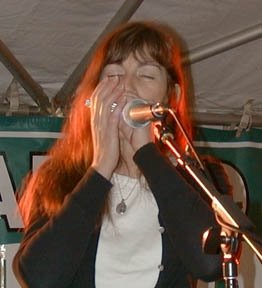
LynnAnn Hyde (left - Kinzel & Hyde)

Where: The New Orleans Creole Restaurant - 114 1st Avenue South, Seattle, WA (206-622-2563)
When: October 6-7, 2006. Showtime is 9:00 PM.
Cover: $10.00

2. The West Coast Rhythm & Blues Summit

For two nights, October 27th and 28th, 2006, The Highway 99 Blues Club in Seattle will become the scene of what amounts to a classic Rhythm & Blues revue.

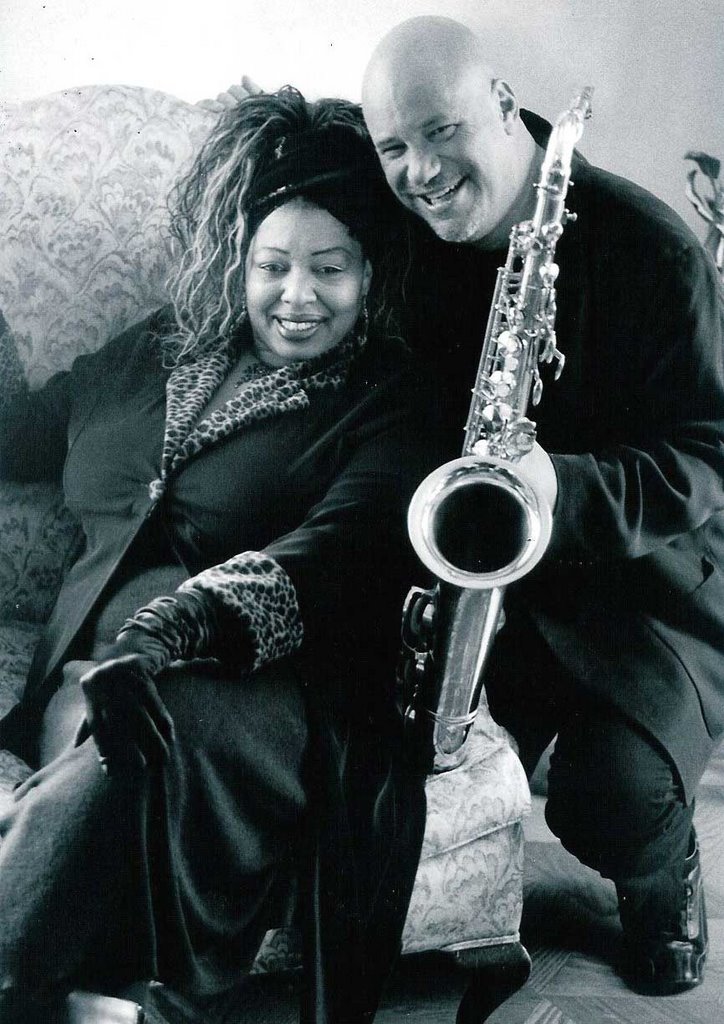
This will be a triple bill, starring Johnny Nocturne (John Firmin - left, with Miss Dee), who the San Francisco Jazz Festival called “The Big Daddy of retro jump-blues tenor saxophone." The show will also star Miss Dee, long time vocalist with the legendary Johnny Otis Show. Miss Dee is the vocalist on the Johnny Nocturne Band CD “Blues Volume”. This portion of the show will also highlight Nocturne keyboard man, Henry Salvia.

The R&B Summit also includes The Crossroads Band, the Washington Blues Society’s “Best Band” of 2005. Crossroads is a five piece group of seasoned veterans. The Tacoma Weekly said about the band’s new CD: “In case you have never seen them play yet, this record makes you want to change this fact as fast as you can.” Special guests are The Three J’s Alaska reunion band, consisting of John Firmin (aka Johnny Nocturne), John Stephan (John Stephan Band), and John Lee (The Crossroads Band). Describing the Three J’s self-titled CD, Misty Blue, the Canadian radio show host, said “ Alaska sure can rock the blues!” Henry Salvia who plays on the 3J’s CD, joins the band.

Master of Ceremonies for the show will be Rock and Roll Hall of Fame disc jockey, Jimmy “Early” Byrd. “Early” Byrd is the first African-American disc jockey elected to the Hall. The other DJ’s in the Hall of Fame are Alan Freed, Wolfman Jack and Dick Clark.

Where: The Highway 99 Blues Club - 1414 Alaskan Way , Seattle, WA (206-517-7864)
When: Friday October 27th and Saturday October 28th 2006. Showtime is 8:45pm.
Cover: $15.00

For additional information call Mr. Solid Productions at 206-517-7864

3. Beale Street or Bust Fundraiser

This is the second in a series of fundraisers to send the 2006 Washington Blues Society's Best Band, Becki Sue & Her Big Rockin' Daddies to Memphis to compete in the International Blues Challenge in February 2007. Becki Sue & Her Big Rockin' Daddies will perform at this event, as will members of the Hudson Blues Band, Harmonica Playboy & the Midnight Movers, and the Crossroads Band. Also scheduled to appear are blues harp ace Dave Prez and guitarist Alice
Stuart
. Three Fender Squire Stratocaster guitars will be raffled off to some lucky fans. Stay tuned for more details on this show.

Becki-Sue & Her Big Rockin' Daddies

Where: The Highway 99 Blues Club - 1414 Alaskan Way, Seattle, WA (206-382-2171)
When: November 12, 2006. Late afternoon to about 10:00 PM (times to be confirmed)
Suggested donation at the door: $10.00

4. Highway 99 Road Rage!!

Harmonica Playboy & the Midnight Movers Vs. Chris Stevens' Surf Monkeys

Recently, the Playboy backed his '77 Coupe DeVille into Chris Stevens' '41 Woody. The damages will be settled out of court with a Battle of the Bands at the Highway 99 Blues club on November 17th.

Seattle's 10 most dangerous blues musicians will converge for some Rollin' and Tumblin' under the viaduct. Three guitars, two saxes, 12 harps, and a pair of dynamite rhythm sections will be Ballin' the Jack and Snatchin' it Back! Load Link Wray's "Rumble" into your CD player as you cruise down to the Highway 99 to re-live the glory days of live blues in Seattle with two great bands highlighting one great show!

Harmonica Playboy (left - photo by Phil Chesnut) & the Midnight Movers:

Mike Lynch (harp/vocals), Tim Sherman and Steve Yonck (guitars), Kirk Tuttle (drums), and Patty Mey (bass).

Chris Stevens' (left - photo by Ronda Lee) Surf Monkeys:

Chris Stevens (guitar), Les Clinkingbeard and Brian Kent (saxes), Mark Dalton (bass), and Alan Isaacson (drums)

Where: The Highway 99 Blues Club - 1414 Alaskan Way, Seattle, WA (206-382-2171)
When: November 17, 2006. Showtime is 8:30 PM.
Cover: $12.00


5. Second Annual West Coast Guitar killers Showcase

Guitarist Tim Sherman will be hosting the Second Annual West Coast Guitar killers Showcase at the Highway 99 Blues Club on November 24th. The featured guitarists this year will include Tim Sherman (The Midnight Movers), Tom Boyle (Becki Sue & Her Big Rockin' Daddies), Chris Stevens (Surf Monkeys), and a rare appearance by David Brewer (left - The Intimidators). The backup band will include Kirk Tuttle (drums), Mark Dalton (bass), and Ron Weinstein (Hammond B-3).

Where: The Highway 99 Blues Club - 1414 Alaskan Way, Seattle, WA (206-382-2171)
When: November 24, 2006. Showtime is 8:30 PM.
Cover: $12.00

Sunday, September 17, 2006

First Avenue Breakdown - Seattle Blues in the 70's

By Mark Dalton

Note: This article first appeared in the Washington Blues Society Bluesletter.

Looking back to the early days of my involvement with the then-fledgling Seattle blues scene, playing the dives and honkytonks of First Avenue stands out foremost in my mind. In fact, as far as playing the Blues in Seattle goes, it always seems to come back to First Avenue - for a blues guy, First Avenue is probably a state of mind as much as a geographic area.

I can go back and listen to tapes that were recorded at "Pig Alley" (still in the Public Market, a.k.a. the Place Pigalle) and at the late lamented Ridge Tavern (where one night we had to step over a large pool of blood to get our equipment in the doorway) that seem to be of some historical interest, and perhaps have musical value for the true fanatic, but the recording quality is so horrible that it would be unkind to subject a normal person to them.

I have other such tapes where the recording quality is pretty good, but the performances are horrible, often due the ingestion of excess quantities of mind-altering chemicals by the band (and everyone else in the place). The performances thus have only a low comedy value, sort of like those "blooper" albums people used to like, or perhaps "America's Funniest Home Videos"... a very low sort of humor indeed, and not something I'd want to inflict on anyone other than a confirmed Three Stooges fan.

But in late 1973, when Tom McFarland and I settled into our five-nights-a-week gig at the Boulder Cafe at First and Pike, I was in heaven. I came out here from Nebraska looking for a real blues bar to pay my dues in, and the Boulder was IT. Anything could happen in the Market in the early 70's, and there was a kind of freedom and energy in the air that was simply exhilarating.

I'd come out with the plan of going to work for harp player Don "Junior Earl" McNeff, but my wife Katha and I screwed around in the Bay Area, crashing on various friends floors, ingesting controlled substances at the beach, seeing Charlie Musselwhite with the Ford Brothers Band in Berkeley, hanging out on Telegraph Avenue, staying a few weeks longer than we planned. By the time I got here, the job was filled, but Tom McFarland had just moved up to Seattle from Portland, and was looking for a steady band.

So I had an audition with McFarland. I came over to his place, which was right off of 10th Avenue on Capitol Hill. His little house had a dirt floor basement, and I brought up my stuff from the car. Precision Bass, rolled and pleated black Kustom amp. I was cool. McFarland came to the door and he had on this black leather car coat, and he had a Budweiser in one hand and a Pall Mall in the other, and he said, "Let's go down in the basement." So I hauled my bass amp down there, and he turned on his brown-faced Fender Pro amp, got out his red Gibson ES-355 stereo guitar, sat down on a stool and poured himself a shot of whiskey from a silver flask,and opened up another Budweiser and put on his finger picks and said, "Well, let's play some Freddie King." He started playing these Freddie King tunes, which I knew, because Id played them all in Nebraska. The Seattle version of Tom McFarland and the Rhythmtones started that way.
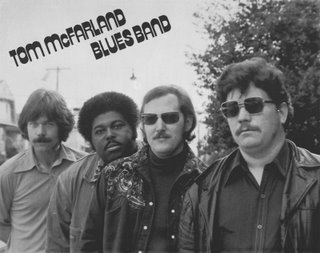
The Tom McFarland Blues Band - mid '70s. Left to right: Peter Brown (drums), Isaac Scott (guitar/vocals), Frank Reich (bass), and Tom McFarland (guitar/vocals).

We played for a couple of hours that first day, and it was great. This guy was exactly the guy I came out to Seattle to play with. We played a few seamy clubs around town, and finally landed a regular gig at the Boulder Cafe on the corner of First and Pike. The Green Parrot porn theater was right next door, and Vyvyn Lazonga was working her first gig as an apprentice in a tattoo parlor just down the street. First Avenue, in those days, was a real scene.

The Boulder Cafe was a 70's version of a go-go joint. It wasn't topless, but they had what were then called B-girls working there, taking turns dancing on a little tiny stage in bikinis, while the rest of the girls mingled with the customers and kept them drinking. The place was all red and black vinyl, and Tony Jones, a rough longshoreman with an occasional heart of gold, was our patron and club manager. Some folks said the Boulder was actually owned by Seattle night life character Frank Collacurcio, but I wouldnt know about that. I do know that Tony Jones was a sort of a Godfather for blues bands at that time. He eventually added a club in West Seattle called The Admiral Tavern to his roster, and both places featured the Blues, and nothing but the Blues.

The Boulder was exactly the kind of place that I came out to Seattle to play in. It looked, and felt like a blues bar. It was a Jack Kerouac kind of a place - filled with working people, mixed with funky hipster intellectuals who would come in to drink and listen to the blues. The whole Market scene at that time was an amazing amalgam of really poor people, street hustlers, black folks, white folks, asian folks, everybody looking for action came down there. The atmosphere felt a little bit dangerous, but just enough to be really interesting. There was always an edge of excitement in the air, because you never knew what was going to happen that night, who would come in or what was going to go down. Every now and then someone would get cut or shot, but they left the band alone, and we played on....

The Public Market and all of First Avenue, that whole community, was Skid Row back then. The area is really quite cleaned up compared to back then, before the forces of gentrification cleared out most of the riffraff and turned it all into a nice little touristy street. First Avenue was not nice back then, but it was a lot more fun after dark than it is today.

In addition to the Boulder, Pig Alley, and the Ridge, live music bars included the Victrola in the lower Market, and the old Mint upstairs (where Little Bill, Joe Johansen and Larry Harris held forth for years on end). Downstairs from the Mint was a joint called Docs, and moving up Pike street there were clubs like Smittys and the Caballero.

In those days playing was everything - We looked for work wherever we could get it. We played on First Avenue a lot because we wanted to be there, and also because those were the guys that would hire us. We'd go out on booking expeditions - I'd go out with Junior Earl, or with McFarland, hitting the clubs on either side of Pike Street, for example. We'd go in and hit the club owners up, and say, "Look. We've got a couple bands here, and we want to play the blues and we're pretty good. We've been playing across the street and they like us over there. Why don't you give us a job." And the club owners would hem and haw around, but in the end they'd often let us play there. They'd pay us a nominal amount of money and we'd play the blues. In some of these clubs, I am sure the owners had a hard time figuring out why we would want to play there at all - these, again, were not nice places - this was skid row - it had a funky kind of authenticity that appealed to us fledgling bluesmen, but to the rest of the world, these joints were strictly for hitting bottom. Only young men and women enamored of the South Side of Chicago could find the kind of success we were looking for here! In any event, here we were, actual live bands, able to play in tune and get the people dancing, and we worked cheap. So we worked a lot.
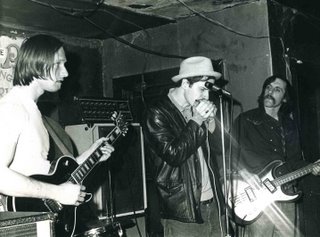
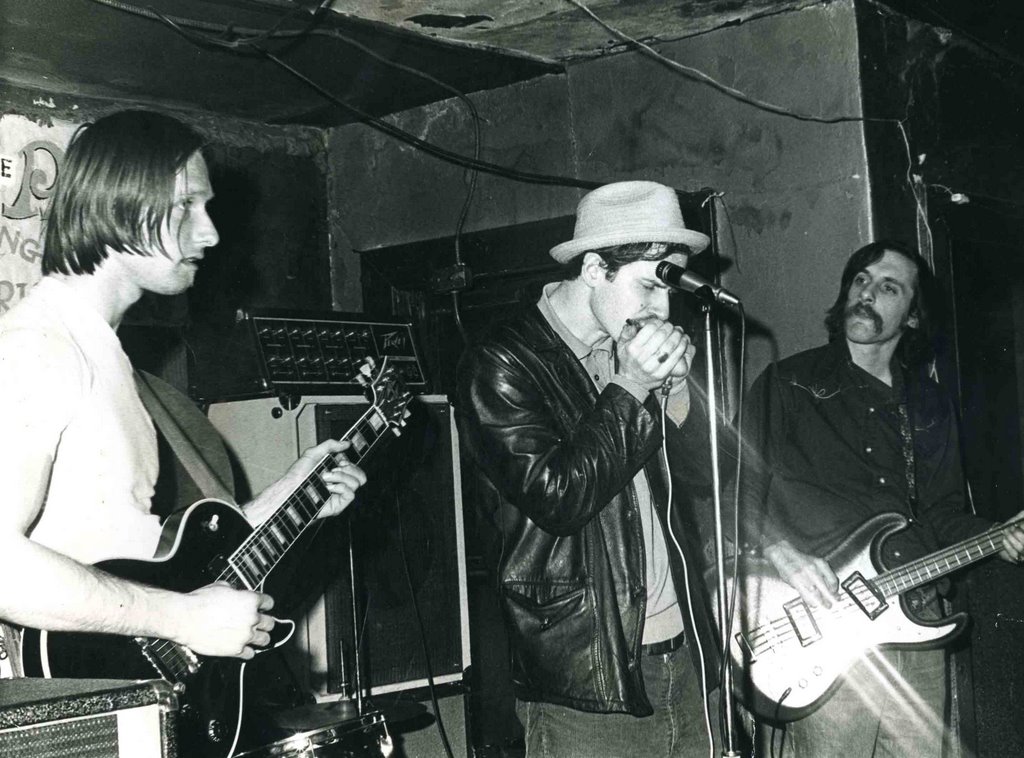
The Gray Blues Band at the Place Pigalle (Pig Alley), Seattle - 1974. Left to right: Jerry Christie, Don "Junior Earl" McNeff, and Keith Duncan (dig the Mosrite bass!).

Pig Alley, or just The Pig, for example, paid $225 for three nights, total, for the whole band. They paid all the bands the same amount of money. No matter how many people in the band, or how good you thought you were, it was $225 for Thursday, Friday and Saturday. Gary, the owner of the Pig, had us over a barrel. There simply wasnt a cooler place to play in the greater Seattle area, and he knew it. "Hey, I dont NEED you guys," he'd say when we complained about the lousy pay. "I got bands lining up to play here." Rather than lose the gig to any of dozens of hipster wanna-bes, we always gave in and came back for that same old money. Some of us would probably be playing there still if Gary hadnt given in to the forces of gentrification and turned one of the greatest Dylan Thomas Slept Here hipster bars in the world into a middling French Restaurant, which it remains today.

While it lasted, the Market Blues Scene was the best - a tight little scene, incredibly ethnically and economically diverse, where the players all knew each other, and everyone was there, week after week, sitting in with each others bands, trading off gigs, hanging out day and night. Bands nurtured each other - trading tunes, trading licks, trading players. The good-sized audience of Blues fans we ultimately attracted supported the bands in every way, including after-gig parties and breakfast in the morning. The pawn shops on First Avenue sold good old guitars cheap (the kind we liked to play). Life was simple, and life was good. If we hadnt been blues people, we might have thought it would last forever... but we'd already been told that good things dont last always. And they didn't. But life goes on, and the Blues does survive, and memories persist.

Note: The photos for this article were contributed by Mark Dalton.
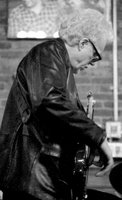
Originally from Nebraska, Mark Dalton moved to Seattle in the early '70s. He is an accomplished bassist and stalwart bluesman. He currently plays with the Chris Stevens Band. Photo by Ronda Lee.
Tuesday, September 05, 2006

Down to the nightclub...

The Blues Orbiters and Jeff & the Jet City Flyers

The kids had two sleepovers last weekend (yes!), so I checked out some of the local blues talent at a couple of Seattle night clubs on Friday and Saturday night.

I drove down to the Corner Inn on Friday night to see the Blues Orbiters. The Corner Inn is about two miles due south of my place in West Seattle. Located on the corner of California Avenue and Fauntleroy, this joint has been hosting live music now for a long time - at least since the late '80s. They have karaoke during the week, and usually a mixture of a few blues bands and low volume classic rock bands on the weekends.

The Blues Orbiters are a five piece band fronted by Brian Lee (left), who sings, plays guitar, slide guitar, and harp. He's got this cool pedalboard that he uses to manage playing all of these instruments through a single Victoria Bassman amp. How does he do it? I dunno, but he gets great tones out of all of his guitars and harp, and doesn't have to spend 10 minutes switching instruments and adjusting the amp.

The rest of the band consists of Ron Baker on saxes, Dan Taylor on guitar, Roger Smith on electric bass, and former Midnight Mover Conrad Ormsby on drums. There was a pretty decent crowd at the Corner Inn that night (for a change) and the band had most of them up dancing to a mixed bag of music that included tunes by Otis Rush, Sonny Boy II, originals off of their new CD "Falling Leaves", and even a cover of the JB's "Pass The Peas."

The band sounded very good - the highlights for me were Lee's slide and harp playing, the unison stuff played by the guitar and sax, and Ormsby's tough drumming. Conrad is one of those unusual drummers that can play both blues and funk with equal authority - his playing on "Pass The Peas" was just right!

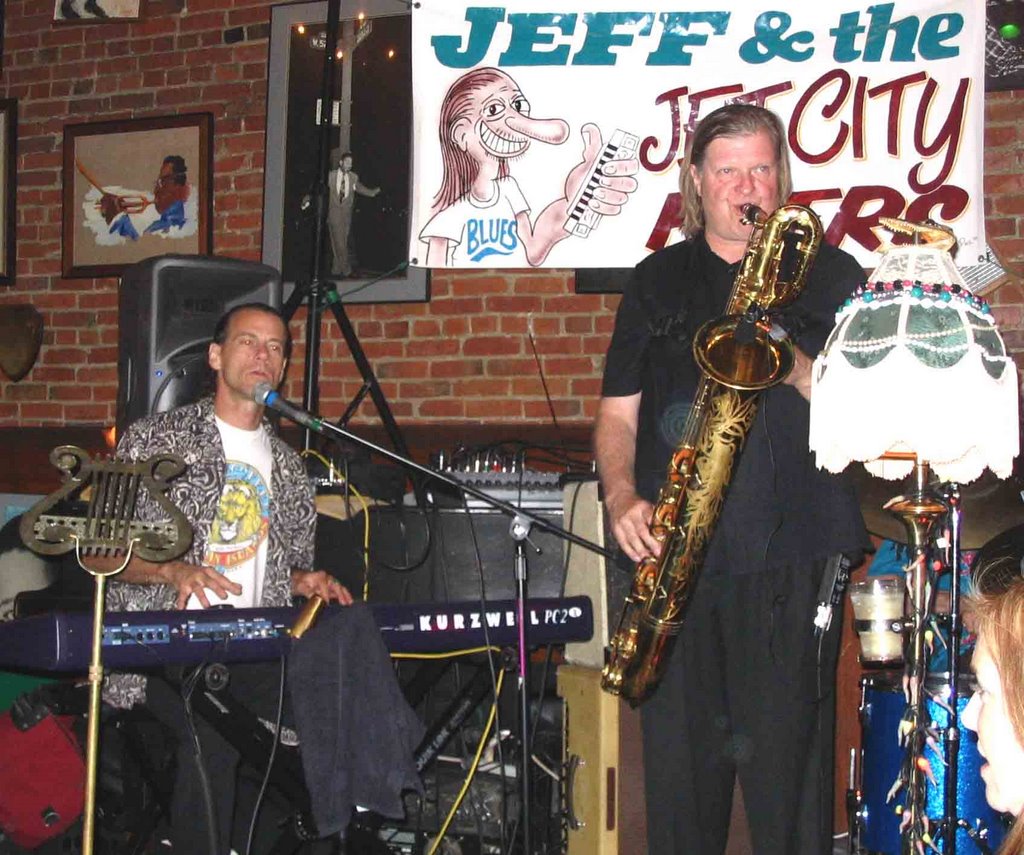
On Saturday night I went downtown to the New Orleans Creole Restaurant in Pioneer Square to see Jeff & the Jet City Flyers. This was the second night of their CD release party, and they had a pretty good crowd, but I guess the club was really packed on Friday night. The band this night included band leader Jeff Herzog on harp and vocals, longtime guitarist Bill Lovey on guitar and vocals, Patty Mey on electric bass, Kirk "KT" Tuttle on drums, the excellent Steve Flynn on keyboards, and John Savage on baritone sax.

Left to right: John Savage, Jeff Herzog, Patty Mey, and Bill Lovey

Steve Flynn and John Savage

The band had the crowd up and dancing with tunes from their new CD, and covers, including JB Lenoir's "Mojo Boogie." I liked the one gospel-flavored tune they did from the new CD called (I think) "I Don't have A Clue." Jeff used his wireless mic to good effect when disappeared into the crowd and played the John Mayall tune "Room To Move." When I left the club he was standing on a table blowing up a storm with a crowd of dancers around him. Good stuff!

I'll say it again - Live music really is best! See you at the nightclub.

Saturday, September 02, 2006

Musings from Mr. Solid

By John Lee

I was visiting my friend Roger Lindgren recently, and I noticed he had a DVD of the documentary “Make It Funky- The Music That Took Over The World.” I had seen this fine film at The Waterfront Blues Festival in Portland, Oregon last year and wanted to view it again. I borrowed Roger’s copy and just got done seeing it one more time. I have to say it is the best film to explain what New Orleans music is and how important the New Orleans sound is to American music.

The brass band street tradition, the second line and Afro-Cuban rhythms are the main factors contributing to the funkiness of the New Orleans sound. The second line being the second wave, returning from a funeral, with upbeat drums leading the charge - the bass drum, keeping the solid beat, and the snare drum working the syncopation. This is likely where funk came from. The film talks about the influence of the piano in New Orleans music and how Fats Domino brought The Big Easy’s music to the world. The film also talks about the Mardi Gras Indian traditions and the social clubs that were a way of bonding and dealing with the “Jim Crow” laws of the day.

“Make It Funky” is narrated by Art Neville of the Funky Meters and the Neville Brothers. A large segment of the film deals with the R & B era of the fifties and sixties with commentary from Aaron Neville, Irma Thomas, Allen Toussaint, Art Neville, Jon Cleary, Bonnie Raitt, and legendary drummer Earl Palmer to name some.

There are some great live performance footage with the likes of Big Sam’s Funky Nation, Allen Toussaint and Irma Thomas (with just piano and Irma’s great vocals), the Neville Brothers, and a great clip from the seventies of Doctor John and Earl King playing with Professor Longhair. Also check out a spry Earl Palmer cookin’ on the drums to “Rip It Up” with vocals by Ivan Neville.

“Make It Funky” was filmed before Hurricane Katrina. It is now one year since Katrina and New Orleans is still in turmoil. A major report lays a lot of blame on the federal government's lack of maintenance of the levees as a big reason for the flooding, which caused the greatest amount of damage to The Big Easy. Now the backbiters and syndicators are trying to make New Orleans into a generic white bread Disneyland with no poor people of color. If the powers that be are allowed to sanitize New Orleans, part of our musical and cultural heritage will die.

“Make it Funky” helps explain the importance of New Orleans and I think will act as a great history lesson. Do yourself a favor and check out this fine film. I hope you dig it as much as I do.

September Blues Birthdays

B.B. King - September 16, 1925
KoKo Taylor - September 28, 1935
Freddie King - September 3, 1934 (died-1976)
Jimmy Reed - September 6, 1925 (died-1976)
Barbeque Bob - September 11, 1902 (died- 1931)
Gus Cannon - September 12, 1883 (died- 1979)
Roy Buchanan - September 23, 1939 (died- 1988)
Z.Z. Hill - September 30, 1935 (died- 1984)

Electric bassist John "Mr. Solid" Lee was born in Alaska and has been active in the Seattle blues scene for about 30 years. He currently plays with the Crossroads Band. Photo by Mike Coyote.
Monday, August 21, 2006

More photos from the vault.

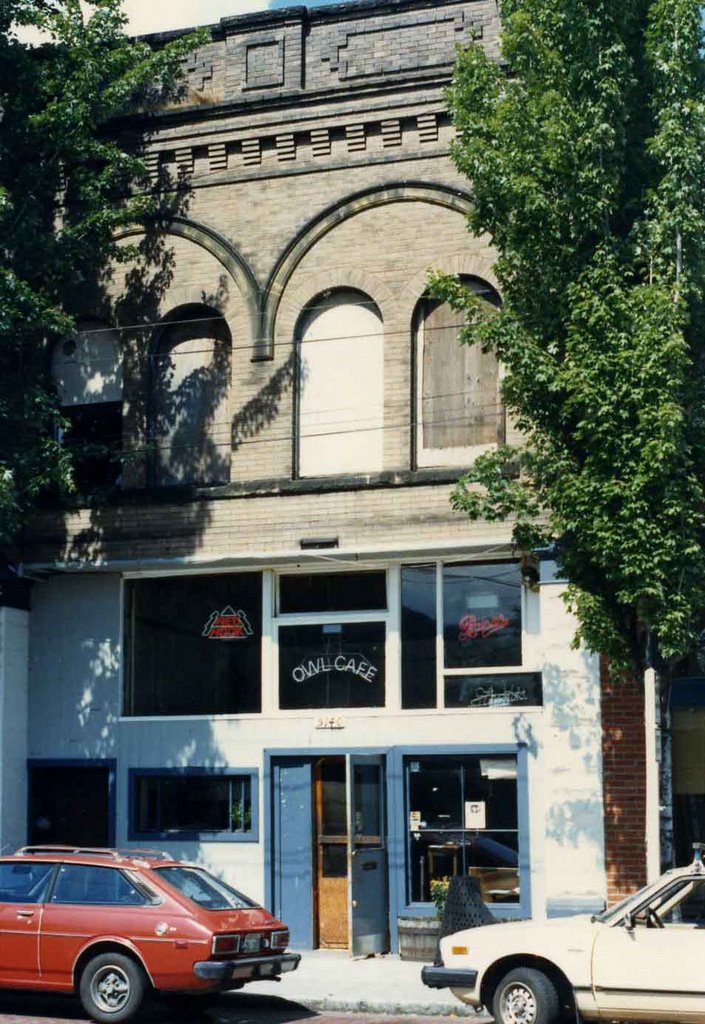
The Owl Cafe (Seattle) 1988-1989

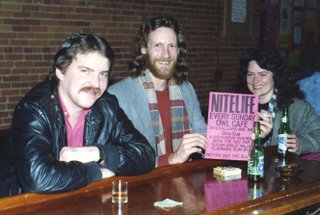
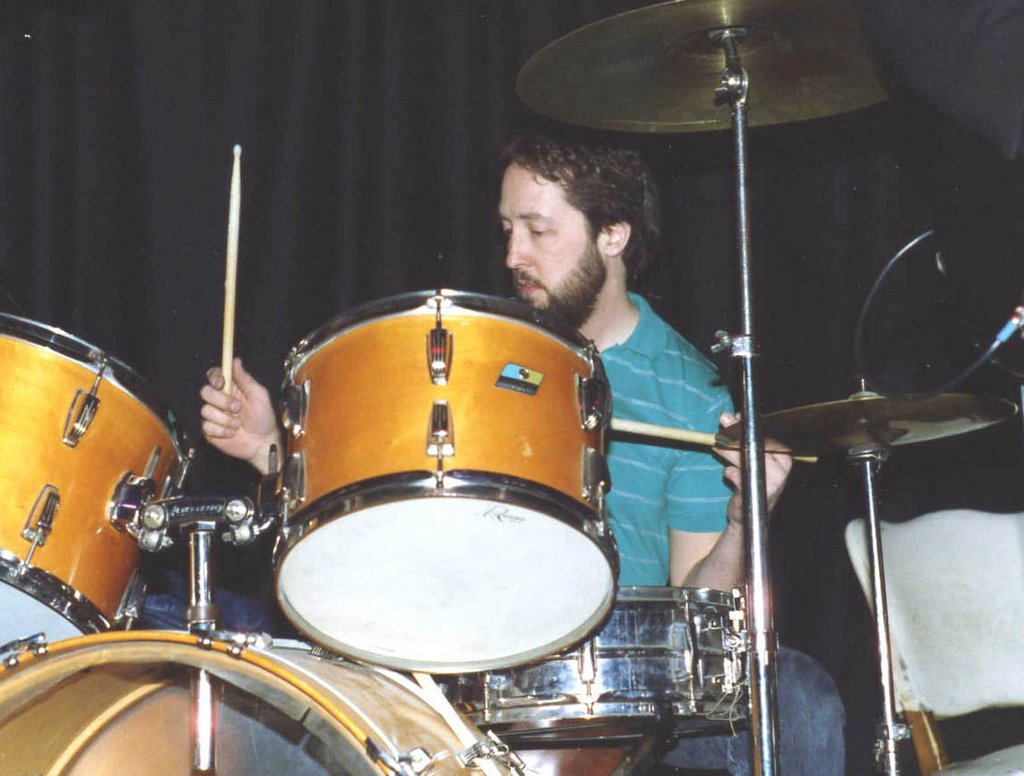
I took these snapshots in and outside of the late great Owl Cafe over a period of a couple of years in the late '80s. This was THE rockin' blues joint in Seattle's north end after the demise of the Jolly Roger Roadhouse. Operated by Patrick "Fatcat" Lynch and Uncle Ray Varner (Ray ran the New Orleans style Mizz Sadie's Kitchen in the Owl), this very popular club featured blues talent from all over the Northwest and the occasional touring act. The Owl was also the home of the long running Blue Monday jam session that started around 1980. Lots of great music happened in this place!

The good times at Owl Cafe eventually crashed and burned around 1992. The joint is still open as an Irish pub known as the Conor Byrne. The Broomdust Blues Band currently hosts a a blues jam at the Conor Byrne one Wednesday a month, but the blues has pretty much moved out of the Ballard neighborhood, with the exception of the regular Thursday night gig at the Salmon Bay Eagles a few blocks away.

The Owl Cafe - Ballard Avenue, Seattle

Left to right: Guitarist Ted Belushi, Cathy Cooper, and Patrick "Fatcat" Lynch

Bluescast. Left to right: Hal Merrill, Kevin Lynch, Peter LaPonte, unknown sax, and Eric Madis

This is most likely the Screaming Blue Jays (Chris Stevens' band). Left to right: Irv Kellenberger, Ron Nation, Howard Hooper, John Hodgkin, and Chris Stevens

Chris Stevens

Left to right: Dan Abernethy, Daddy Treetops, and unknown fan

Jim Mesi

Jack Cook (playing with Trouble at Home)

Kirk Tuttle (playing with Trouble at Home)

Kathy Hart and unknown fan

Kirk Tuttle and Jimi Jean

Drummer Les Hutchinson

Les Merrihew

Lloyd Jones

Tom McFarland and Mike Lynch

Left to right: Jim Mesi, Tom McFarland, and drummer Homer Leon

Left to right: Patty Mey, Kirk "KT" Tuttle, and Ron "Deacon" Weinstein

Nitelife. Left to right: Mark Dalton, Tom Boyle, Ron Weinstein, Larry Harris, and Mike Lynch

Tom Boyle

Daddy Treetops and Jack Cook

Trouble at Home. Guitarist Russ Meltzer and John Marshall

The Rockin' Rick Band. Left to right: Les Merrihew, Rockin' Rick, Jim Mesi, Mike Lynch, and Patty Mey

Note: Do you have photos of events at the Owl cafe that you would like to share with the Jet City Blues readers? If so, contact me at slapbackslim@yahoo.com and we'll figure out at way to publish them. Thanks!